Choosing the Best Stairlift Rail
If you’re considering a stairlift, one of the first things to think about is how it will fit on your stairs. How is the rail secured? Whether the rail might sit on the bottom stair? What is the rail length? Can it go around corners? What if you have a door at the bottom and need the rail to fold up and out of the way?
There are several factors to take into account and it can be difficult to know where to start. Fortunately, we’ve got you covered! In this article, we’ll highlight the different types of stairlift rails, their dimensions and how their various features and options can help make your home safer.
Types of Stairlift Rails
On a basic level, there are three main types of stairlift rail: straight, curved and outdoor. Each of these rail types is suited to a different type of staircase and the rail type you’ll need will depend on where you want to get your stairlift installed. Let’s take a closer look, so you can figure out which rail option is best for you.
Straight Stairlift Rail
The most common staircase is straight making the straight rail the most popular. Straight rails are mass-produced and cut to length to fit on your staircase. They’re typically silver in colour and made of aluminium. The best rails will be scratch-resistant.
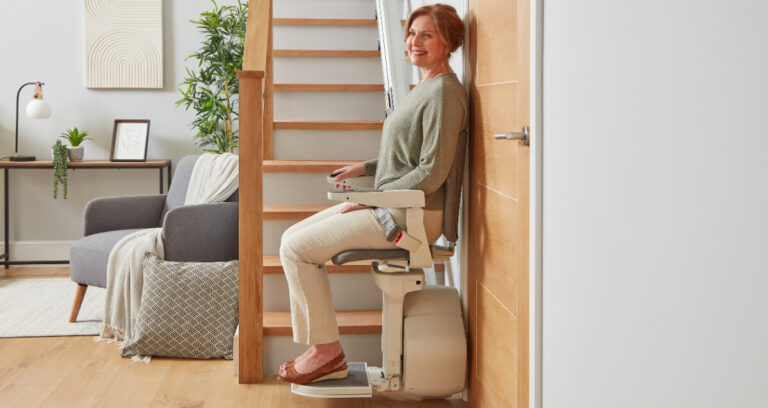
In terms of your straight staircase’s dimensions, the only real concerns are stair width and head clearance. As long as you have sufficient head clearance for the user and your stairs are a minimum of 28” wide, installing a straight stairlift shouldn’t be a problem.

Straight Rail Dimensions
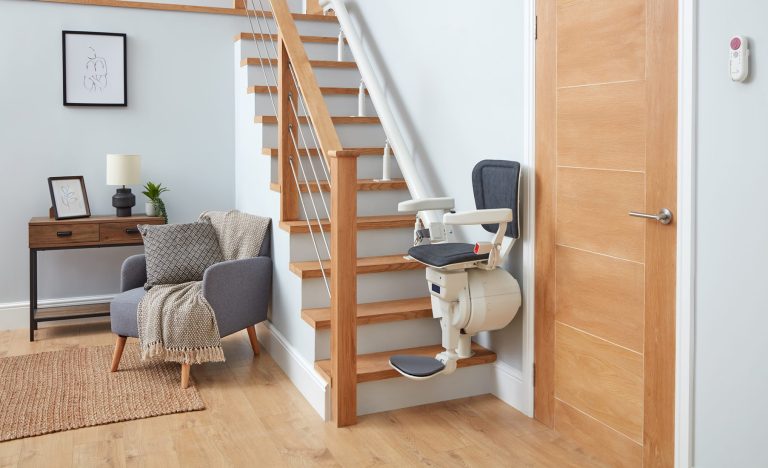
Straight rails are fitted with a charging strip that provides a constant charge, powering the stairlift’s battery, regardless of where you decide to park the chair. The rail itself only sticks out about 6” onto the staircase, leaving plenty of room for others to get by. Contrary to popular belief, the rail is fixed to the stair treads, not the wall. This is much more secure and causes far less damage to your home, as it doesn’t require any major modifications.
It typically requires just a few screws to attach the legs to the treads on every other stair. The only other important factor to consider is that the rail will likely stick out around 18” at the bottom of the staircase, so the stairlift has a place to land. If you have a door or walkway at the bottom, you might need to consider some additional options.
Powered Folding or Retractable Rail Option
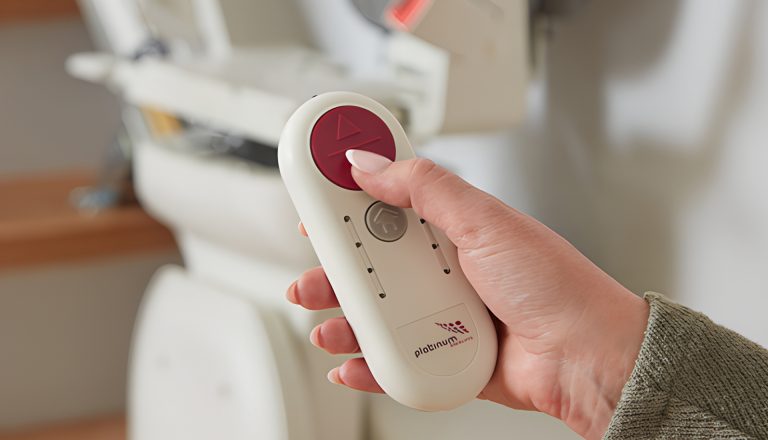
The Retractable Rail Option, also known as hinged rail, is the perfect solution for obstructed landings at the bottom of a straight staircase. The rail folds up and down with the push of a button, clearing space at the bottom of the stairs and providing a safe landing for your stairlift on the ground floor. Once you’ve disembarked, you can send the stairlift back upstairs remotely and the retractable rail will fold up and out of the way, until you’re ready to use it again.
Curved Stairlift Rail
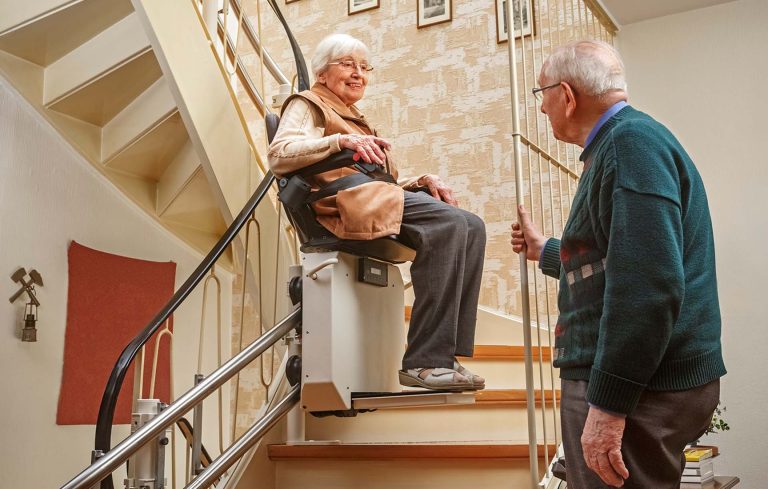
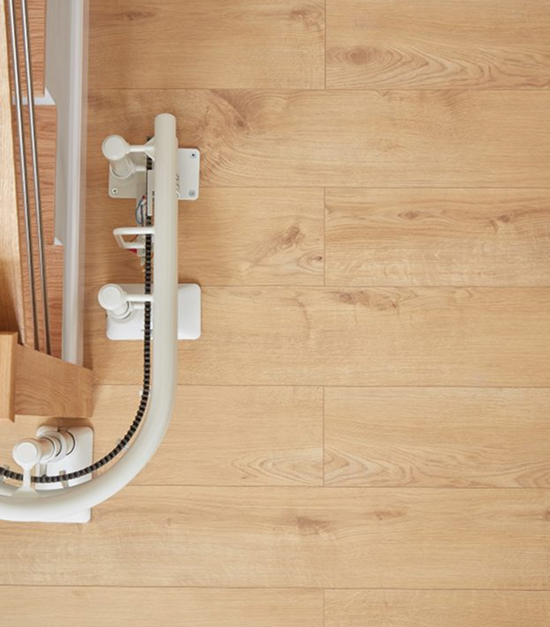
If your stairs make a turn, have an intermediate landing or include multiple flights, you’ll likely need a curved rail stairlift. Curved rails are more complicated than straights. They have to be custom-made to handle the bends and turns of your stairs while maintaining a smooth and level ride. Unlike straight staircases, where the stair width is relatively consistent, curved staircases often include pie-shaped stairs and variant widths that need to be accounted for.
Curved stairlifts can be installed on either side of the stairs making an inside turn or going around an outside bend. Regardless of which side you choose, Leodis Stairlifts will take precise measurements to design a custom-made rail to fit perfectly on your staircase.
Luckily, there are usually a variety of solutions and options. You can choose everything from the color of the rail to how and where the stairlift starts and finishes.
The Retractable Rail Option, also known as hinged rail, is the perfect solution for obstructed landings at the bottom of a straight staircase. The rail folds up and down with the push of a button, clearing space at the bottom of the stairs and providing a safe landing for your stairlift on the ground floor. Once you’ve disembarked, you can send the stairlift back upstairs remotely and the retractable rail will fold up and out of the way, until you’re ready to use it again.
Custom Curved Rails
When choosing Leodis Stairlifts, our surveyor will measure your stairs, and then we will design, manufacture and install your custom/bespoke rails that are a tighter fit and offer a smoother ride. The twin-tube design is popular, but the characteristics of the rail can vary.

Modular Curved Rails
Modular rails, meanwhile, are often single tube and boast a quicker delivery time. However, the ride quality isn’t as smooth as a custom rail and it is important to note that if you have a complicated staircase with very tight turns, you might need a tailor-made rail to fit precisely your staircase.
Curved Stairlift Rail Dimensions
Curved rail dimensions vary depending on the specifics of your staircase. Given that each curved staircase is different, it’s hard to give approximate dimensions for stairs that turn. Long, straight sections can have rail protrusions that are similar to the 6” typically seen on straight stairlifts, but it’s difficult to say how far the rail will stick out where it makes corners. However, bespoke rails are known to hug turns significantly tighter than modular stairlift rails.
Considering a Stairlift? We Know You May Have Some Questions…
Does a stairlift decrease the value of a house?
No. In most cases, a stairlift will not decrease the value of your home. As our stairlifts are always fitted directly to the staircase rather than the wall, they can be removed with very little evidence. Any small fixing holes in the stair treads can typically be repaired, leaving your staircase ready for its next owner.
Our stairlift buy back service and free removal service help keep your options open if you decide to move home in the future, subject to your stairlift’s warranty status and condition.
How long does a stairlift installation take?
Our expert, friendly engineer will install a straight stairlift in around 2-3 hours. Curved stairlifts take a little longer, but we should still be done and tidied within 4-5 hours.
Once the installation is complete, your Leodis engineer will clear away any packaging, and leave your stairway clean and tidy. They will then show you how to operate your stairlift, let you try it out, and answer any queries you may have. Only when you are satisfied do you pay.
How long will I have to wait for my stairlift?
Depending on whether you’ve ordered a new or reconditioned model, this usually takes just a few days. We also offer next-day installation in urgent cases.
24/7 Care
24/7, 365 days a year customer care & call-outs.
Warranty
2 years comprehensive parts & labour warranty.
Replacement parts & batteries
We will always leave you with replacement parts and batteries.
Check-in calls
We always check-in with our customers after install.